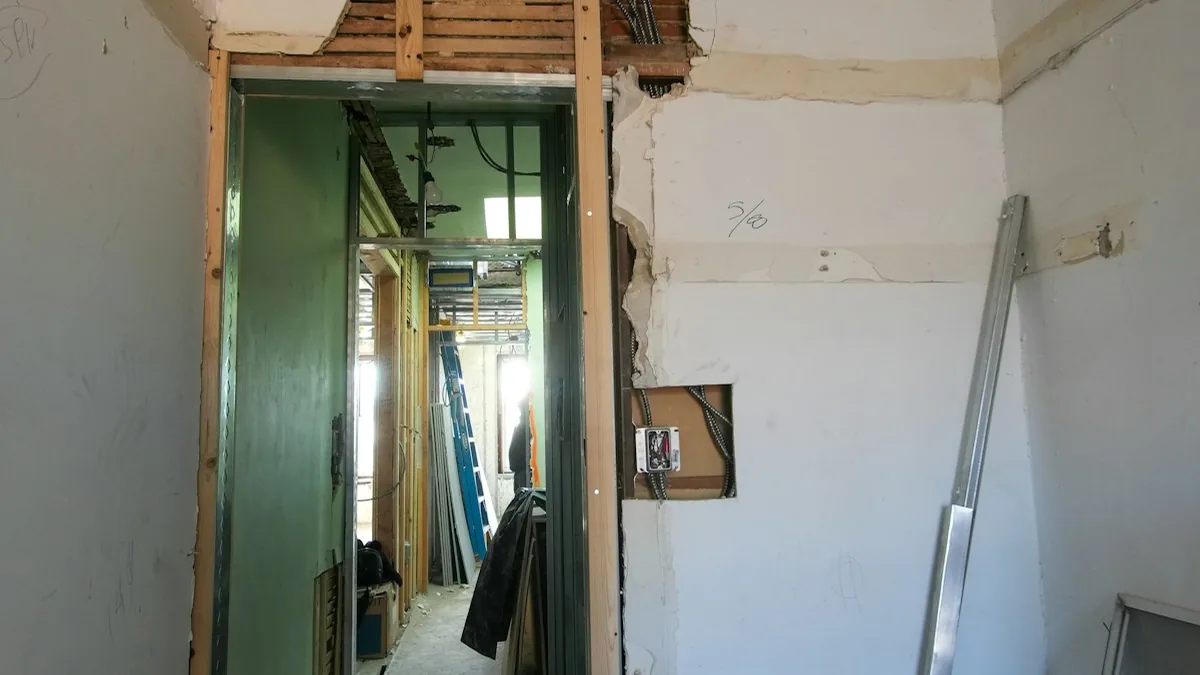
Describe the finished condition
A budget estimates the cost of producing a defined result. Without a clear scope, two contractors can quote the same property and price very different work. Begin with the intended finish, permitted use, materials, and condition you expect at completion. Connect that result to the valuation model rather than spending for features your likely buyer does not value.
Separate visible work from investigative work. A paint estimate is different from an allowance for damage behind a wall. If a hidden condition could materially change cost or timing, identify how you will investigate it and what decision depends on the result.
Break the job into measurable components
Use a room-by-room or trade-by-trade scope with quantities, unit assumptions, and exclusions. Specify whether a price includes labor, material, demolition, disposal, permits, delivery, and cleanup. A quote that excludes several necessary items is not cheaper than a complete quote simply because its total is lower.
For a hypothetical flooring item, 1,200 square feet at $6 per square foot is $7,200 before any omitted preparation, waste, transitions, or disposal. Verify how the contractor measures area and what the rate includes. Do not use the example as a market price.
Create a comparison that respects scope
Ask contractors to price the same written scope. Then compare exclusions, assumptions, payment schedule, change-order process, qualifications, insurance, and availability. Obtain appropriate professional input about licensing, permits, inspections, and safety for the jurisdiction and work.
Keep a bid log with dates and open questions. If one proposal includes subfloor repairs and another assumes sound subfloor, the difference is not just price. Clarify the underlying condition and agree how unexpected work will be documented before it occurs.
Budget time and carrying costs
A project schedule should show dependencies: inspections, permit lead times, material delivery, rough work, close-up, finish work, and final approvals. Do not assume every trade can work simultaneously. Delays in one dependency can push back several tasks and the sale or rental date.
Connect the schedule to interest, utilities, taxes, insurance, maintenance, and loan maturity. A $2,000 material saving that causes two additional months of carrying costs may not improve the project. Compare total consequences rather than isolated line items.
Use contingency as a risk response
Contingency should reflect actual uncertainty, scope maturity, property condition, and your ability to absorb changes. There is no universal percentage that makes every project safe. Distinguish contingency for identified unknowns from a general buffer, and avoid using either to conceal known work.
For a $40,000 defined scope, an illustrative $6,000 contingency brings the planning budget to $46,000. If an inspection identifies $12,000 of additional necessary work, update the scope and model instead of pretending the original buffer solved it. The right response may be a lower acquisition price or passing on the project.
Create a scope boundary for every major trade
A trade line should explain where the work begins and ends. For a kitchen, specify whether demolition, disposal, wall repair, plumbing reconnection, electrical changes, appliances, counters, and painting belong in the same package or separate packages. Mark who coordinates the interfaces. A collection of individually reasonable bids can still omit essential work if every contractor assumes another trade will perform it.
Prepare a scope map using a simple status for each item: included in a named proposal, excluded and separately budgeted, investigation pending, or intentionally outside the project. Avoid an ambiguous “by owner” note without a cost and responsible person. If you plan to supply materials, record ordering, delivery, storage, compatibility, and damage responsibility. The point is not to write construction specifications beyond your expertise. It is to give qualified contractors and project professionals a clear account of the intended result and expose gaps before those gaps become extra invoices.
Distinguish quantities, unit rates, and allowances
A measured quantity and an estimated unit rate are different assumptions. If a flooring package uses 1,000 square feet at a hypothetical $5 per square foot, the starting amount is $5,000. If the installer confirms 1,080 billable square feet because of the applicable measurement and waste convention, the same rate produces $5,400. Confirm how the quote measures the work so you do not add a separate waste allowance already included in its quantity.
An allowance is a placeholder for an unresolved selection or scope item. Label what it covers and what happens when the actual selection differs. A $2,000 fixture allowance does not establish that a desired package costs $2,000 or that installation is included. Record the person responsible for resolving it, the decision date, and the likely consequence for budget and schedule. A well-defined allowance helps progress while details are being settled. An unlabeled allowance can conceal known work and make an early total look more complete than it really is.
Resolve investigations before closing up work
Identify decisions that depend on conditions not yet visible. Ask the qualified contractor or specialist what investigation is appropriate, what it costs, and how findings will be documented. Plan the investigation early enough to inform scope and sequencing. Do not assume every hidden condition can be discovered cheaply or without disruption, and do not undertake unsafe or specialized investigative work yourself.
For a hypothetical bathroom renovation, the visible plan may include fixtures and finishes, while the condition behind a damaged surface remains unresolved. Record a separate investigation task and a decision point before the affected work is covered. If findings expand the scope, request a written change with cost and schedule effects. The initial budget should show the uncertainty honestly rather than claiming the finished package is fixed. This process also helps you avoid completing decorative work that must later be disturbed to address a necessary underlying repair.
Compare bids through a reconciliation meeting
After receiving proposals, put the same scope items beside each contractor's response. Highlight missing quantities, exclusions, assumed site conditions, and items described only as “as needed.” Ask each bidder to clarify those differences in writing. Avoid inserting your own assumption that a low total must include the same work as a higher one. Compare the clarified packages with the intended finished condition and the available budget.
Suppose one hypothetical bid is $32,000 and excludes $5,000 of separately estimated disposal and preparation, while another is $36,000 and includes that work. On those limited inputs, the first package totals $37,000 before other differences. That does not establish which contractor is better; timing, qualifications, insurance, communication, and scope clarity still matter. It does show why the original $4,000 price gap was misleading. Keep the reconciliation so the eventual award reflects an understood scope rather than a total detached from its assumptions.
Track committed cost as well as cash paid
Maintain separate columns for original budget, approved changes, current budget, commitments, payments, and forecast cost to complete. A contractor payment is not the same as completion, and a low paid balance does not mean the project is under budget. Unpaid approved work still matters. Likewise, an unapproved change request should be visible without being silently treated as an accepted commitment.
For example, an original $40,000 scope plus $3,000 of approved changes creates a $43,000 current budget. If $24,000 has been paid, $15,000 of committed work remains unpaid, and $6,000 of additional work is expected, the forecast final cost is $45,000. The forecast exceeds the current budget by $2,000. Check that the $6,000 is not already included in the unpaid commitments. This reconciliation identifies the likely final outcome before every invoice arrives and gives you a basis for discussing the remaining scope with the responsible professionals.
Price schedule choices using the whole consequence
For a material or contractor substitution, compare purchase savings with timing, installation, compatibility, and rework implications. A less expensive item can be sensible, but the decision should reflect the actual project dependency. Ask the project professional whether work can continue productively while waiting or whether the item blocks an important next step. Not every delay extends the final completion date by the same amount.
Suppose a hypothetical alternative saves $1,200 but adds four weeks to the completion window. If those four weeks truly add $1,600 of carrying costs and $300 of extra site-related expense, the change increases total modeled cost by $700. If the project has other work during the wait and completion does not move, that calculation changes. Record which schedule assumption supports the choice. Avoid using carrying costs as a slogan to justify every rush charge; calculate the marginal consequence of the specific decision and verify whether the schedule effect is real.
Build a completion record that improves the next estimate
At completion, reconcile the final approved scope with invoices, payments, unresolved requests, and required professional documentation. Record remaining corrective items with owners and dates. Ask the appropriate professionals which inspections, warranties, approvals, and payment-related records are needed for your project. Keep product and contractor information accessible to whoever will operate or maintain the finished property, subject to appropriate privacy and retention practices.
Then compare the initial estimate with the final cost by cause: changed finish choices, measured quantity differences, hidden conditions, omitted work, rate changes, and schedule effects. Preserve both the original estimate and the explanation. If three projects repeatedly omit the same preparation work, update the estimating checklist rather than raising a general contingency percentage and forgetting the cause. Your own records can become useful estimating evidence when the scopes and conditions are comparable. A final cost per square foot without that context is just another summary number that may mislead the next budget.
Hold a short prestart scope review
Before work begins, review the agreed scope with the responsible contractor and relevant project professionals. Confirm unresolved selections, access arrangements, investigation tasks, material responsibilities, and the next required decision. Ask each participant to explain the handoff they depend on. A practical conversation can reveal that a material delivery, inspection, or preparation task has no owner even when every trade has supplied a price.
Record the decisions and update the budget or schedule where necessary. Do not rely on a verbal clarification that changes cost while leaving the written scope unchanged. The goal is a shared understanding of the work you are actually committing to fund, with remaining unknowns visible and assigned before those unknowns interrupt construction.
Control changes and verify completion
Use written change records with description, price, schedule effect, authorization, and evidence of completion. Track approved changes separately from pending requests. Reconcile invoices with the scope and payment milestones. Obtain professional advice about lien waivers, inspections, and required closing or lender documentation.
At the end, compare budget, commitments, paid amounts, and remaining work. Preserve the lessons in your estimating library, including what was missed and why. A reliable rehabilitation budget improves over time because the original scope and actual outcome remain visible.
- Define the finished result.
- Measure quantities and exclusions.
- Compare equivalent scopes.
- Confirm permits and trade requirements.
- Connect schedule to carrying costs.
- Log changes before payment.
- Reconcile actual outcomes.
Trace the reasoning.
Adapted from the academy’s published guide. Open the original guide ↗
General education; all examples are hypothetical. Source review: October 27, 2026. Verify current facts, property evidence, and applicable professional requirements. No transaction result is promised.