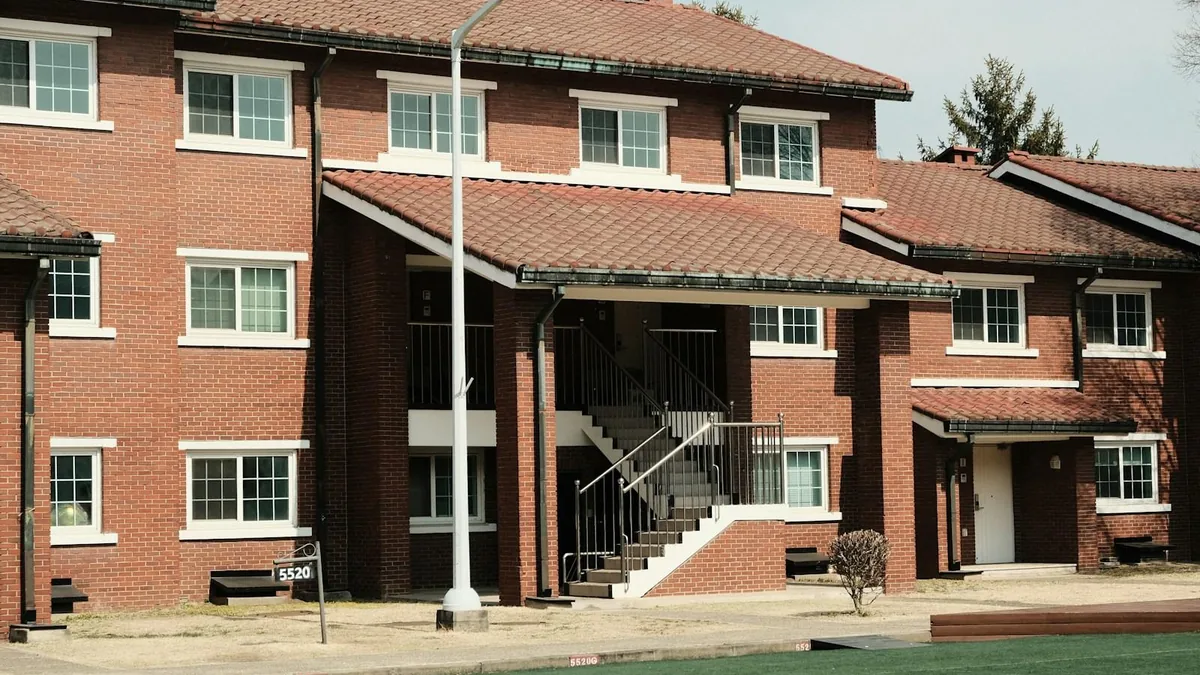
- Create a component inventory with condition and remaining-life evidence.
- Calculate a simple replacement contribution and its limitations.
- Build a dated reserve cash-flow schedule.
- Separate immediate work, routine repairs, capital replacements, and liquidity.
- Test early failure, cost escalation, and portfolio concentration.
Reserve for physical obligations rather than a convenient percentage
A capital expenditure reserve sets aside cash for substantial property components that wear out or require major renewal. A percentage of rent can be a useful preliminary allowance, but it does not reveal which components must be replaced, when the money is needed, or whether current cash is sufficient. A recently renewed roof and an aging roof can produce the same rent while requiring very different funding plans. Start with the physical assets and their condition, then calculate what the property must contribute.
This guide treats capital replacements as a planning category distinct from routine repairs and ordinary operating expenses. It does not determine accounting or tax classification. A repair restores a functioning item within the routine budget; a planned component replacement consumes a larger amount at a less frequent interval. The exact boundaries should match the property’s management and financial reporting practices. State them explicitly so that replacing an appliance is not included in both the annual maintenance allowance and the component reserve schedule without an intentional reconciliation.
An immediate known deficiency also needs different treatment from a future replacement. If an inspection identifies work required at acquisition, place it in the initial project budget and funding plan. Do not pretend a slow monthly reserve contribution will pay a bill due next week. The purpose of the reserve is to make future physical obligations visible before they become emergencies. It sits alongside, rather than replaces, an operating cash buffer for vacancy, delayed collections, insurance deductibles, or other interruptions.
Build the component register from evidence
Create a row for each significant component or component group: roof sections, heating and cooling equipment, water heaters, appliances, flooring, exterior surfaces, paving, and other property-specific assets. Record quantity, installation information where supported, observed condition, expected work, current replacement cost estimate, remaining service-life range, and evidence source. Photos, invoices, inspection reports, and qualified contractor observations strengthen the record. An approximate age supplied verbally is a lead to verify, not a fact that must remain unchanged in the model.
Remaining useful life is an estimate of future service under the observed conditions, not a countdown guaranteed by a manufacturer’s general lifespan. Installation quality, use, climate exposure, maintenance history, and hidden conditions can matter. Ask a qualified professional what evidence supports the estimate and what signs would require earlier action. Use a range when the information is uncertain. A component that appears serviceable during a brief visit can still fail early; the plan needs funding flexibility rather than confidence derived from an exact-looking year.
Fannie Mae’s condominium Full Review guidance includes a reserve-study framework addressing major components, condition, remaining life, costs, and funding analysis. That is a specific lending and project-review context, not a universal standard for every rental. Its component-based logic is useful background for the educational planning method here. The amounts, lives, contribution choices, and decision rules in this guide are hypothetical original examples. A property-specific reserve study or professional assessment may be needed when the assets or uncertainty justify it.
Calculate an easy baseline and expose what it assumes
Consider a hypothetical rental with four planning groups. A roof is estimated to cost $12,000 to replace in six years, heating and cooling equipment $8,000 in four years, a water heater $2,000 in five years, and an appliance group $3,000 in three years. Assume these estimates are in today’s dollars and initially ignore interest and cost escalation. Assume no reserve cash has yet been allocated to these items. The simple annual contribution is each replacement estimate divided by its assumed remaining years.
The roof therefore requires $2,000 per year, the heating and cooling group $2,000, the water heater $400, and appliances $1,000. The total is $5,400 annually, or $450 monthly. This is a transparent first-pass funding rate, not a claim that all components will fail on their assumed dates. It assumes steady contributions begin immediately, no other withdrawals occur, the cost estimates are complete, and the full stated life remains. Document those assumptions beside the result instead of treating $450 as a permanent property expense allowance.
Notice how different this method is from using original purchase price or rent as the main driver. Component cost and timing determine the contribution. If the roof’s remaining life falls from six to three years with no existing funds, its annual amount doubles from $2,000 to $4,000 even if rent stays unchanged. If there is already money allocated to the roof, subtract that amount before dividing by the remaining funding period. Do not subtract the entire shared account balance from every component row.
| Component group | Current replacement estimate | Assumed years remaining | Baseline annual contribution |
|---|---|---|---|
| Roof | $12,000 | 6 | $2,000 |
| Heating and cooling | $8,000 | 4 | $2,000 |
| Water heater | $2,000 | 5 | $400 |
| Appliances | $3,000 | 3 | $1,000 |
| Total | $25,000 | Different dates | $5,400 ($450/month) |
Check the calendar because an average can still run short
An annual contribution total is only a starting point. Build a cash-flow schedule that shows opening reserve balance, contributions, replacements, and ending balance for each period. For an initial simplified schedule, assume $5,400 is contributed at the end of each year and replacements occur just after that contribution in their assigned year. Starting at zero, the reserve ends years one and two at $5,400 and $10,800. In year three, another $5,400 arrives and $3,000 appliances are replaced, leaving $13,200.
Year four adds $5,400 and pays $8,000 for heating and cooling, leaving $10,600. Year five adds $5,400 and pays $2,000 for the water heater, leaving $14,000. Year six adds $5,400 and pays $12,000 for the roof, leaving $7,400. This aggregate illustration demonstrates the first replacement cycle under intentionally simplified timing. It is not a complete long-term funding study because the replacement of the appliances in year three begins a new service cycle that must also be modeled.
The order of payments matters. A bill due in January cannot be funded by a contribution planned for December unless cash already exists. Use monthly periods when near-term obligations are large or contributions are uneven. Rebuild each component’s schedule after replacement using the new cost evidence and assumed service cycle. A flat $5,400 contribution may not remain appropriate after some components are renewed and others approach failure. The useful test is whether the dated account balance stays adequate through the actual sequence, not whether the six-year total looks sufficient.
Incorporate existing reserves and cost changes consistently
Suppose the account already holds $6,000 that is genuinely available for these replacements and not committed to unpaid bills or other purposes. In a component allocation example, assign $3,000 to the roof, $2,000 to heating and cooling, $500 to the water heater, and $500 to appliances. The remaining annual contributions become $1,500, $1,500, $300, and approximately $833, totaling about $4,133 a year. This allocation is a planning convention; the actual cash may remain pooled if the applicable account arrangements permit it.
Existing cash does not eliminate timing analysis. A pooled account can temporarily cover a component that fails early, but using that cash removes funds expected to support the other items. Recalculate the entire schedule after a withdrawal. Also distinguish accessible owner-controlled cash from amounts held under lender or other restrictions. An account statement showing a balance does not prove that every dollar can be used for any repair on demand. Record permitted uses, request procedures, documentation, and expected disbursement timing in the cash plan.
Cost escalation should be explicit. If the $12,000 roof estimate grows by an assumed 3% each year for six years, the future estimated cost is about $14,329. With no existing allocation and no interest earned, the six-year annual roof contribution becomes about $2,388 rather than $2,000. The 3% rate is only a scenario input, not a forecast of construction prices. Avoid applying inflation again to a contractor estimate already stated as a future-date cost, and obtain refreshed estimates rather than extending an old assumption indefinitely.
Test early failure and clustered replacements
The baseline zero-balance plan accumulates $10,800 by the end of year two. If the roof must be replaced at that point for $12,000, the reserve is $1,200 short even before considering the other components. If the roof fails after eighteen months of $450 monthly contributions, only $8,100 has accumulated, leaving a $3,900 gap at the same replacement cost. These examples show why a long-run contribution rate cannot substitute for adequate opening liquidity when existing components are already worn.
Now consider a clustered scenario in which the $12,000 roof and $8,000 heating and cooling group both require replacement at the end of year two. The $20,000 cost exceeds the $10,800 accumulated balance by $9,200. Costs could also rise together because multiple jobs share labor or material exposure. Do not assume failures are independent merely because they occupy different spreadsheet rows. Components installed during the same renovation may age together, and severe weather or a maintenance problem can affect several systems at once.
For each meaningful gap, choose a practical response before the event: fund more opening cash, increase contributions, change the acquisition budget, obtain better condition evidence, revise the timing assumptions, or decline an obligation you cannot support. Do not assume an emergency loan or future refinance will be available on acceptable terms. A contingency plan can identify potential funding options, but it must distinguish funds already accessible from options requiring another party’s future approval. The reserve schedule should expose the gap, not erase it with an unsupported financing assumption.
Link replacement planning to operations and portfolio cash
Routine maintenance can influence service life, but do not automatically count every maintenance payment as a reduction in replacement funding. A service visit may reduce failure risk without changing the eventual replacement cost or eliminating the need for a reserve. Track maintenance tasks, condition changes, and replacement recommendations together. If evidence supports extending a component’s life estimate, revise it with a dated explanation. Avoid repeatedly extending estimates solely to keep distributions high or to make an underfunded schedule appear balanced.
Ownership responsibilities determine the inventory. A condominium association may handle some common components, while the unit owner remains responsible for interiors and may face other obligations. A leased equipment arrangement can change payment timing without removing all exposure. Identify who maintains, replaces, and funds each item through appropriate document review; this guide does not interpret those obligations. Keep the funding plan aligned with the responsibilities actually established rather than assuming that a fee paid to someone else covers every future physical cost.
For a portfolio, maintain property-level schedules and a combined cash calendar. Pooling cash can create flexibility, but it does not reduce total physical obligations. If three homes each have a roof approaching the end of its service range, shared liquidity may face three demands at once. Mark funds restricted to particular properties and avoid counting the same shared cash as the full emergency reserve for every asset. The portfolio review should show the combined low balance under clustered work and the additional cash the owner could supply without disrupting other commitments.
Operate the reserve as a regularly reviewed funding plan
At each review, reconcile opening cash, actual contributions, approved commitments, payments, and closing cash. Update the component register for completed work, new inspections, changed cost estimates, and revised timing. Separate a transfer into the reserve from an actual external expenditure. When analyzing operating cash after reserve contributions, explain how later spending is treated so the same dollars are not deducted twice in a holding-period return. Financial reporting can use different conventions, but the cash reconciliation should always remain reproducible.
Create a distribution rule tied to the forward schedule rather than the visible account balance alone. Cash that appears idle may be needed for a roof shortly after the next review. Before releasing funds, check upcoming replacements, outstanding invoices, the adverse timing case, and any account restrictions. If the plan is underfunded, record the gap and the funding action rather than quietly reducing replacement estimates. A reserve account becomes useful when deposits, withdrawal decisions, and physical condition information stay connected over time.
The actionable takeaway is a component register plus a dated funding schedule. Identify what can wear out, verify condition and cost, estimate a range of timing, calculate contributions, and test early or combined failure. Keep an operating buffer separate and refresh the plan as evidence improves. No chosen monthly contribution can guarantee that every future bill will be covered. The goal is to make likely obligations visible, build cash before they arrive, and recognize promptly when the property requires more capital than its current plan provides.
- Inventory components and responsibility for each.
- Separate immediate work from future replacement funding.
- Record condition, cost evidence, and a remaining-life range.
- Allocate existing funds only once.
- Test dated balances, escalation, and clustered failures.
- Reconcile actual cash and refresh the schedule after every major replacement.
Keep the evidence close.
Primary source in the condominium project review context illustrating component inventories, condition, remaining life, and reserve study analysis. Used for those limited concepts, not as a rule for every rental property. Directly reviewed 2026-10-27 (America/Chicago).
Reference checked October 27, 2026.General U.S. education. All numerical examples are hypothetical and exclude costs unless expressly included. This is not individualized financial, investment, tax, or legal advice. Verify property-specific facts and consult qualified professionals. Next editorial review: 2027-01-27.